Buckles through the ages: Roman to post-medieval
Roman D-shape, Saxon trapezoidal, medieval double-loop, post-medieval shoe buckle. Two thousand years of fastening hardware, period by period.
Buckles are the second most common artefact found by UK detectorists after coins, and they span every period from the Roman through to the 19th century. The form changes recognisably era to era — a Roman buckle doesn’t look like a Saxon buckle, a Saxon buckle doesn’t look like a Medieval buckle. Here’s the framework.
Roman buckles (1st–4th c. AD)
Roman buckles are functional and small. The standard form is a D-shape or rectangular frame, often with a narrow plate folded over to attach the strap. Military buckles (from belts and harness) are by far the most common Roman buckle finds; civilian buckles are rarer.
- Module: typically 15–25 mm across the frame.
- Decoration: often plain. Some military buckles have moulded decoration on the frame or inlaid enamel.
- Material: copper-alloy almost always; some tinned or silvered surface treatments survive.
- Period skew: most UK Roman buckles are 2nd–4th century. The very late Roman (5th c. transition) buckles overlap stylistically with early Saxon types.

Anglo-Saxon buckles (5th–11th c.)
After the Roman withdrawal, buckle styles in Britain shift sharply to the migration-period and early Anglo-Saxon repertoire. The characteristic 6th- and 7th-century “great buckle” from Sutton Hoo and elsewhere is at the high-status end; common Saxon buckles are simpler trapezoidal or oval frames.
- Migration period (5th–mid 6th c.): D-shape or oval frames, often with chip-carved decoration. Iron common alongside copper-alloy.
- Middle Saxon (mid 6th–8th c.): oval / D frames with cast plate; Style I and Style II zoomorphic decoration on the plate.
- Late Saxon (9th–11th c.): smaller, simpler buckles; oval D-frames with little decoration.

Medieval buckles (1100–1500)
The medieval period produces the widest range of buckle types of any era. Egan and Pritchard’s Dress Accessories c.1150–c.1450 (1991) is the standard reference and organises them into a typology that PAS uses directly. The principal categories:
| Type | Date range | Description |
|---|---|---|
| D-shape | 1150–1450 | Simple D-frame, one of the most common medieval finds. Plain or with cast knops |
| Oval | 1150–1450 | Single oval frame; widely varied sizes |
| Rectangular | 1250–1500 | Rectangular with central bar; for wider straps |
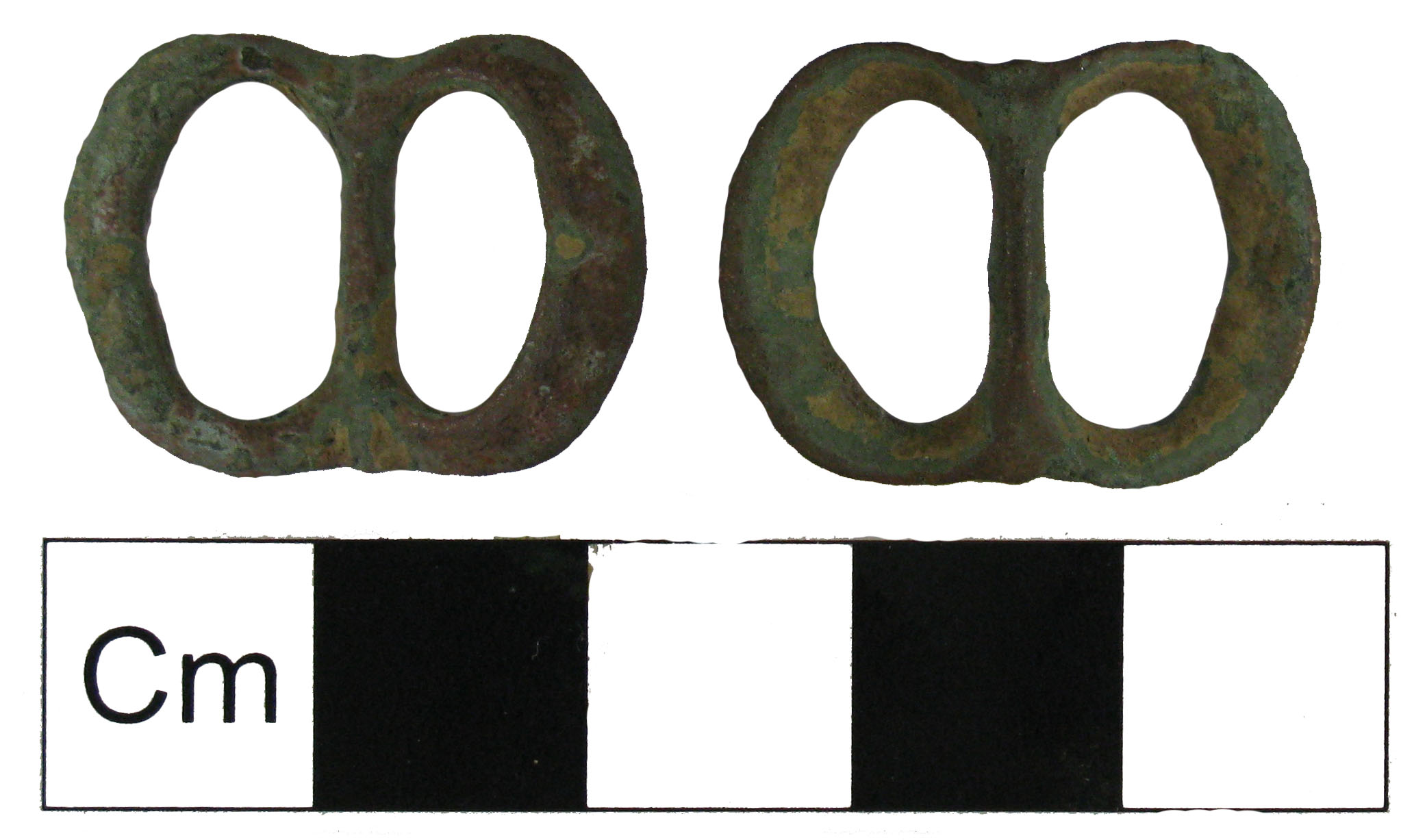
| Double-loop oval | 1250–1450 | Two adjacent oval frames; very common 14th c. |
| Asymmetric / heart-shape | 1300–1450 | Stylised heart shape; often well-decorated; 14th–early 15th c. |
| Annular | 1150–1450 | Open ring with cross-bar; uncommon |
| Lobate | 1250–1450 | Multiple ornamental lobes around the frame; decorative high-status |
| Sexfoil / multifoil | 1300–1450 | Frame divided into six or more lobes |
Post-medieval buckles (1500–1900)
Post-medieval buckles include several distinctive categories:
Shoe buckles (17th–18th c.)
Rectangular frames with a chape (the metal piece that grips the strap). Often elaborate, decorated in cast brass, gilded copper-alloy or even precious metals. Stuart and early-Georgian shoe buckles are 30–50 mm across and visibly ornate. Georgian shoe buckles are larger and more refined.
Harness buckles (16th–19th c.)
Functional buckles for horse harness and carriage tack. Often large (40–70 mm), plain D or rectangular frames, sometimes with a maker’s mark on the back.
Belt buckles (16th–19th c.)
Rectangular or oval frames in copper-alloy, brass or pewter. Often carry a regimental mark for military issue, or a maker’s stamp for civilian.
Spectacle-frame buckles (17th–18th c.)
Twin oval or circular frames joined by a central bar, resembling a pair of spectacles. Specific to a few decades around 1700.
Detecting Roman vs Saxon vs Medieval
On a worn buckle, period attribution comes from form before decoration. The diagnostic sequence:
- Module. Tiny (10–20 mm), plain, possibly Roman. Mid-sized (20–30 mm), decorated plate: Anglo-Saxon possible. Large (25–50 mm), two-loop oval or rectangular: medieval likely.
- Frame style. Plain D-shape: Roman or early medieval. Decorated trapezoidal with plate: Saxon. Double-loop oval: high medieval (14th c.).
- Decoration style. Roman geometric / inlay: 2nd–3rd c. Style I zoomorphic: early Saxon. Foliate, gothic, heraldic: medieval.
- Patina. Green-brown smooth: usually Roman / Saxon. Brown / chocolate: medieval common. Pinkish-brown unleaded brass: post-medieval.
Buckle plates and chapes
Many surviving buckles include a separate plate (the rectangular piece that wraps around the strap end and is riveted to it) or chape(a separate decorative cover for the strap end). Plates often carry the decorative intent of the buckle — chip-carved Saxon Style II zoomorphics, engraved medieval foliage, gilded post-medieval crowns — while the frame stays relatively plain.
Treasure Act implications
Buckles are routinely notTreasure under the 1996 Act unless they’re precious-metal (gold or silver buckles do qualify if 300+ years old). Most copper-alloy and brass buckles fall outside the criteria. Voluntary PAS recording is, however, well worth doing — the typology depends on a steady supply of find-spot data. See our Treasure Act guide for the criteria.
Procedural identification
- Describe the form: D / oval / rectangular / double-loop / lobate / asymmetric.
- Note module and weight.
- Identify decoration style: geometric (Roman), zoomorphic (Saxon), foliate / heraldic (medieval), gilded ornate (post-medieval).
- Match to typology. Egan & Pritchard for medieval; Mackreth for Roman context; Thomas for Saxon strap-end context (which often pairs with buckles).
- Record with PAS. Buckle typology is dependent on find data; every recorded buckle strengthens the corpus.
Try DetectID on a real find
Upload a photo, add anything you measured, and we’ll return a calibrated shortlist with period, denomination, ruler and reasoning chain — the same diagnostic logic the guide above is built on.
Identify a find