George III copper: the cartwheel and the evasion tokens
George III's copper coinage 1760–1820. The 1797 cartwheel penny, the Soho mint issues, and the evasion tokens that filled the small-change gap.
George III (1760–1820) struck more copper coinage than any other British monarch before him — and produced one of the most recognisable individual coins in numismatic history: the 1797 “cartwheel” penny, an enormous 40 mm copper disc weighing nearly an ounce. His coinage is also notorious for the flood of unofficial “evasion” tokens that filled chronic small-change shortages.
The small-change crisis
Between the 1750s and the 1790s, the Royal Mint struck no copper penny coinage. Halfpennies were struck irregularly and farthings almost not at all. Britain’s expanding industrial economy needed small change in vast quantities — for wages, for bread, for everyday transactions — and the lack of official copper from the Mint led to two improvised solutions: forgeries of existing official halfpennies (often crude) and unofficial “evasion” tokens (privately issued, deliberately designed to look enough like official coinage to circulate but not so similar as to be technically counterfeit).

The 1797 cartwheel issue
Matthew Boulton’s Soho Mint in Birmingham was contracted to strike a new copper coinage in 1797. The design philosophy was radical: each penny was to contain exactly one penny’s worth of copper, eliminating the incentive to counterfeit. The result is the “cartwheel”:
- Cartwheel penny (1797): 40 mm, ~28 g, dark chocolate-brown copper. Raised rim around obverse and reverse carries the legend in incuse (recessed) lettering. Heavy enough to use as a paperweight.
- Cartwheel twopence (1797): 41 mm, ~57 g. Even heavier; one of the largest official British coins ever struck. Now scarce as a detector find — the bulk was withdrawn and melted within a generation.
The Soho copper coinage (1799 and 1806–07)
Boulton’s Soho Mint continued striking penny, halfpenny and farthing coinage for the Crown in 1799 and 1806–07. These are smaller and lighter than the cartwheel but still distinctively Soho:
| Denomination | Module | Weight | Years |
|---|---|---|---|
| Penny | 34 mm | ~18.9 g | 1797, 1806–07 |
| Halfpenny | 29 mm | ~9.4 g | 1799, 1806–07 |
| Farthing | 23 mm | ~4.7 g | 1799, 1806–07 |
Britannia on the reverse is recognisable but the design varies between issues — the 1799 Britannia faces left without a spear; the 1806–07 issues face slightly differently. The reverse legend reads BRITANNIA in incuse lettering on the cartwheel and in raised lettering on later Soho issues.
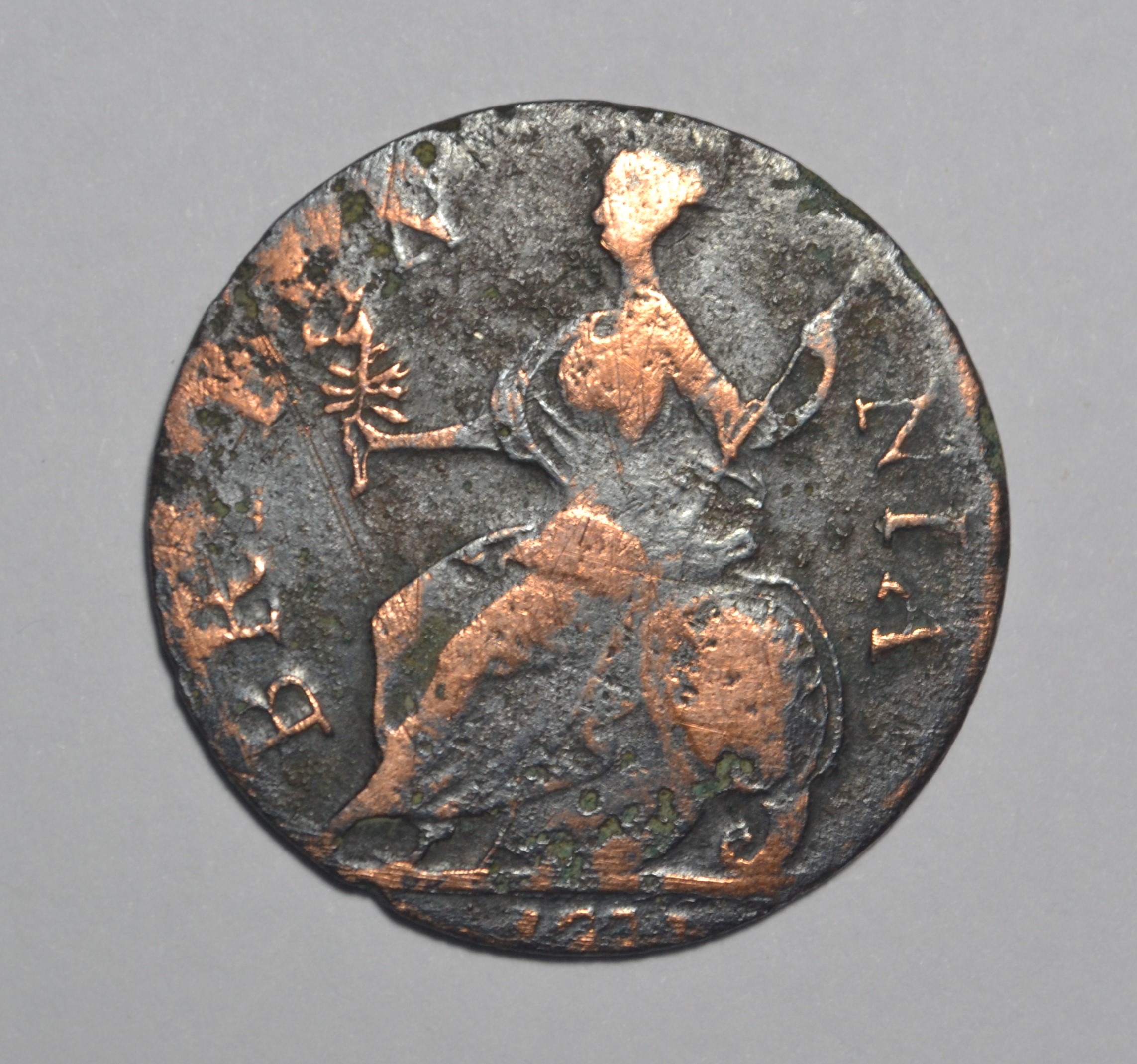
Evasion tokens (c.1770s–90s)
Evasion tokens fill the gap before the 1797 cartwheel reform. They look superficially like George III halfpennies but with subtle differences designed to evade counterfeiting law:
- Misspelled monarch name:
BONNY GIRL,GEORGE RULES,NORTH WALES,BRITISH,SUFFOLK— close enough toGEORGIVSto be mistaken for it at a glance. - Misspelled Britannia:
BRITAINS ISLES,BRITTANNIA,BRITANIAwith a deliberate letter change. - Substitute figure on reverse: sometimes a standing female figure, sometimes a ship, sometimes a horse — not quite the official seated Britannia.
Evasion tokens were not technically counterfeit because they did not exactly imitate the official design or legend. They circulated widely as small change and turn up as detector finds in considerable numbers. They’re recorded by PAS as a legitimate find category.
The pre-cartwheel halfpennies (1770–75)
Before the 1797 reform, George III halfpennies were struck at the old Royal Mint in the Tower of London. They’re smaller and lighter than the cartwheel halfpennies:
- Pre-cartwheel halfpenny (1770–75): 28 mm, ~9.5 g. Halfwhirl-style head, Britannia seated facing left on reverse with no spear.
- Pre-cartwheel farthing (1771–75): 23 mm, ~4.7 g. Same design, smaller scale.
Trade tokens (1787–1800)
Distinct from evasion tokens, “trade tokens” were privately-issued halfpenny and penny tokens struck by merchants and manufacturers between roughly 1787 and 1800 to provide the small change the Royal Mint wasn’t supplying. They carry the issuer’s name and town: JOHN WILKINSON IRONMASTER, PETERLOO HALFPENNY, ANGLESEY MINES, SHREWSBURY. Often well-engraved and aesthetically more sophisticated than the official coinage they were replacing. See our tokens and jettons guide for the wider context.
Procedural identification
- Confirm copper: distinctive red-brown patina, weight matches the table for the size.
- Read the obverse legend.
GEORGIVS IIIon official coinage. Misspelled variants (BONNY GIRL,NORTH WALES) signal an evasion token. Town or surname (JOHN WILKINSON,SHREWSBURY) signals a trade token. - Read the reverse. Britannia seated for official coinage; substitute figures (ships, horses, female personifications) for evasions.
- Read the dateif visible. Cartwheel = 1797. Pre-cartwheel = 1770–75. Soho minor = 1799 or 1806–07.
Try DetectID on a real find
Upload a photo, add anything you measured, and we’ll return a calibrated shortlist with period, denomination, ruler and reasoning chain — the same diagnostic logic the guide above is built on.
Identify a find